
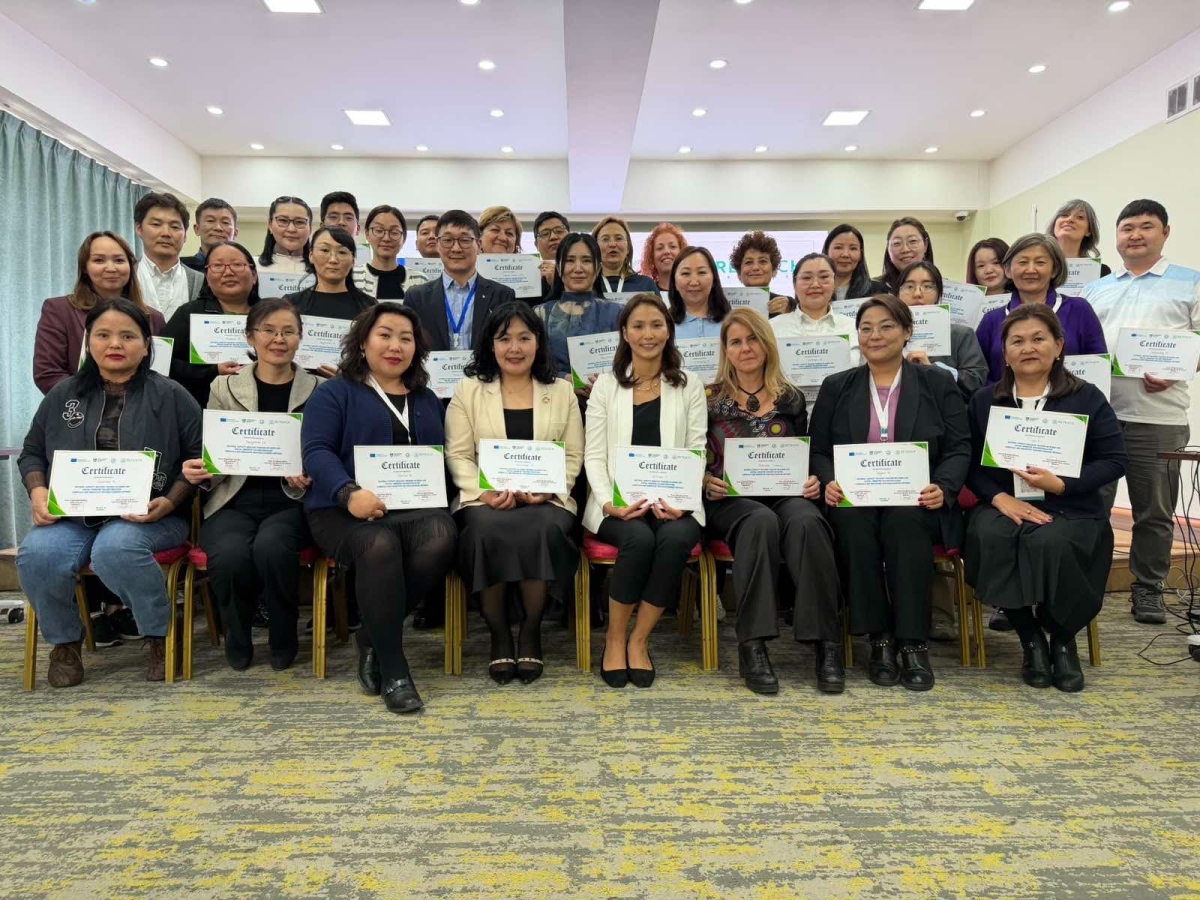
The “Capacity-Building Training on Curriculum Development and Innovative Teaching and Learning Methodologies” was successfully held in Ulaanbaatar from 2–6 June 2026 within the framework of the ERASMUS+ RETEACH project, “Reforming Teacher Education Programmes in Mongolia for Green and Digital Transition”.
The project is coordinated by Otgontenger University in partnership with the Ministry of Education of Mongolia, the General Authority for Education, the National Institute for Educational Research, Transilvania University of Brașov (Romania), the University of Palermo (Italy), CESIE (Italy), the Mongolian National University of Education, the Eastern Regional School of the National University of Mongolia, Khangai University, and Darkhan College. The Mongolian National University of Education hosted this national training event.
The opening ceremony was attended by H.E. Ina Marčiulionytė, Ambassador of the European Union to Mongolia, Dr. N. Enkhzaya, Rector of Otgontenger University, and Prof. J. Batbaatar, Rector of the Mongolian National University of Education, who highlighted the significance and expected impact of the project on the future development of teacher education in Mongolia.
Throughout the five-day training programme, international experts including Prof. Daniela Popa and Prof. Codruța Jaliu from Transilvania University of Brașov, Prof. Elena Mignosi, Prof. Antonella D’Amico, and Eliana Danzì from the University of Palermo, as well as Federico Mallei and Rita Quisillo from CESIE, shared their expertise and experiences with Mongolian teacher educators and academic staff.
The training focused on competence-based curriculum design, the integration of the GreenComp and DigComp frameworks into teacher education programmes, innovative and learner-centred teaching approaches, project-based learning, assessment of green and digital competences, practicum and mentorship development, and quality assurance mechanisms for revised programmes.
Participants engaged in collaborative workshops and practical activities aimed at revising and strengthening teacher education curricula. Institutional teams worked on refining programme learning outcomes, competence maps, assessment frameworks, implementation indicators, and quality assurance plans, while receiving feedback and recommendations from European partners.
On the final day, participating higher education institutions presented the progress achieved during the training, shared the revisions made to their programmes, and outlined action plans for the next stage of implementation and piloting.
As a result of the training, participating institutions enhanced their capacity to align teacher education programmes with the Green and Digital Competence Framework for Teachers, promote student-centred and sustainability-oriented learning environments, and develop competence-based assessment and quality assurance systems. The training also laid a strong foundation for the piloting and implementation of the revised teacher education programmes.
The event concluded with a closing ceremony and certificate awarding session, marking an important milestone in the ongoing efforts to modernize teacher education in Mongolia and support its green and digital transformation.